How Do Noise-Cancelling Headphones Work?

Noise-cancelling headphones have become a must-have accessory for many – especially those seeking solace in their music or craving a quieter environment amidst the hustle and bustle of daily life. But as you delve into the world of noise cancellation, you’ll likely be confronted with a heap of audio jargon and confusing technical terms. In this blog post, we’re going to demystify noise-cancelling technology, explain how it works and offer a few tips to help you choose the right pair of noise-cancelling headphones for your listening needs.
Types of noise cancellation on headphones
There are two main types of noise cancellation, both of which are equally important when it comes to blocking external sound.
Passive noise cancellation works by creating a physical barrier between you and any unwanted noise. Picture yourself sitting at a restaurant when suddenly the fire alarm goes off. The sound is unbearably loud, so you instinctively cover your ears with your hands to muffle the noise. By doing so, you’ve created a physical barrier between your ears and the sound of the alarm. The ear cups on over-ear headphones work similarly in this way, but the degree in which noise is blocked depends largely on how tight the seal is around your ears.
Active noise cancellation, on the other hand, is far more intricate. This technology relies on a complex system of microphones, sound processors and speakers to effectively neutralise external noise. Let’s break it down further.


How does Active Noise Cancellation work?
You don't need to be an audio engineer to understand the basic principles of Active Noise Cancellation (ANC) technology. A good analogy will do. For the sake of this blog, all you need to know are the rules of the game 'tug of war'. If it’s been a while since you’ve played this at school, let us refresh your memory...
In tug of war, two teams are pitted against each other in a test of strength. The teams are positioned on the opposite ends of a rope, with the goal of pulling the rope in the direction away from the opposing team.
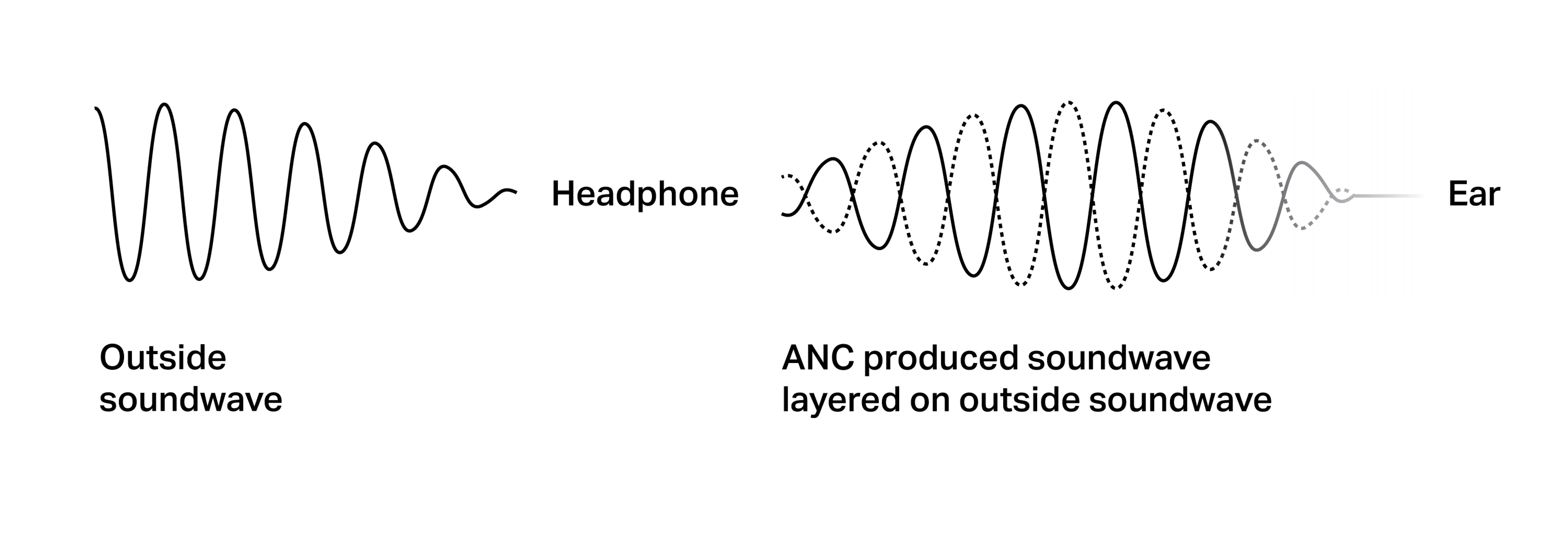
If both teams tug with the same force, the rope won’t move in either direction because each team’s strength is cancelled out. Soundwaves work in a similar way: If one sound wave meets another soundwave that’s the same in frequency and opposite in amplitude, the two sounds will cancel each other out.
While tug of war by no means encapsulates the complexity of sound physics, this should at least give you a basic idea of how Active Noise Cancellation works. Headphones with ANC use tiny microphones inside the ear cups to continuously analyse the sound of your surrounding environment. The microphones identify the frequency and amplitude of the external sounds. Then ANC uses this information to create a soundwave that’s the exact opposite. This contrasting soundwave gets played through the internal drivers on your headphones and, voilà, the unwanted noise is eliminated. The diagram below should help visualise what this process looks like.
Can ANC work with no music or sound playing?
The beauty of noise-cancelling headphones is that they work even when no music or sound is playing. But most headphones with ANC are designed to work in tandem with some degree of ambient noise due to the 'masking effect', which refers to the phenomenon where your brain perceives the absence of sound when it’s masked by an opposing sound.
Say you’re sitting on a crowded train and the person sat across from you is talking on the phone. When you put on your headphones, you’re still likely to hear a bit of muffled chatter. But once you start playing some music, your neighbour’s conversation suddenly disappears. This is because your brain is now taking in more sensory input (your music) and is less focused on the conversation happening in the background.
Ultimately, the effectiveness of ANC will vary depending on the quality of the headphones and the surrounding noise levels. In quieter environments, such as a library, ANC can still noticeably reduce background noise without any music or sound playing. But in louder environments, playing some white noise or other type of ambient sound allows ANC to work at its best. A quick search on your preferred music service should provide you with a variety of options.
Where do noise-cancelling headphones work best?
Noise-cancelling headphones work in a variety of environments where external noise may disrupt your concentration or relaxation. Here’s a list of some places where noise-cancelling headphones are especially worth their while:
- Flights
- Public transport, such as a bus, train or underground metro
- Offices with chatty coworkers
- Coffee shops
- Gyms
- Shared study spaces, like a library
But noise-cancelling technology won’t excel in all environments. Let’s discuss some of the pitfalls you should expect from noise-cancelling headphones.
Why do I still hear noise when using noise-cancelling headphones?
As previously mentioned, ANC is most effective when some amount of ambient noise is present, whether from your headphones or surrounding environment. This is because ANC excels at blocking low-frequency sounds, like the hum of an airplane or drone of an engine. These low-frequency sounds produce long soundwaves, which are a lot easier to block because they tend to be more constant in your environment, ultimately giving your headphones enough time to analyse and produce the best opposing soundwave.
On the other hand, high-frequency sounds – like the honk of a car horn or wail of a crying baby – tend to happen much more sporadically. These sudden noises are more difficult for ANC technology to block because the sound is often gone before your headphones have had enough time to produce a defending soundwave.
So, to recap, passive noise blocking methods (like ear muffs) are best at drowning out high-frequency sounds, while ANC is best at reducing low-frequency sounds. This is why choosing a high-quality pair of noise-cancelling headphones is especially important, so that sound is both passively and actively blocked. Sonos headphones, for example, features an adjustable headband and memory foam ear cushions to create an exceptional acoustic seal that passively blocks high-frequency sounds, while Active Noise Cancellation handles the lowest frequencies. You get the best of both worlds for the most serene listening experience.
Experience Active Noise Cancellation with Sonos Headphones
For those looking to experience the tranquil power of noise-cancelling headphones, Sonos Ace Ultra offers the perfect blend of superior fit and functionality for the frequent flier and office worker alike. With advanced Active Noise Cancellation, Sonos Ace Ultra effectively quiets your surrounding environment, so you can focus on your work and studies, or simply be at peace with your music. Plus, when you want to hear what’s going on around you, Aware Mode lets in some ambient sounds so you’re always in tune with your environment. You can browse Sonos Ace Ultra and other Sonos headphones here.


